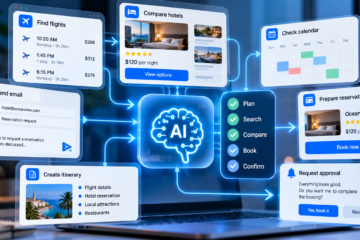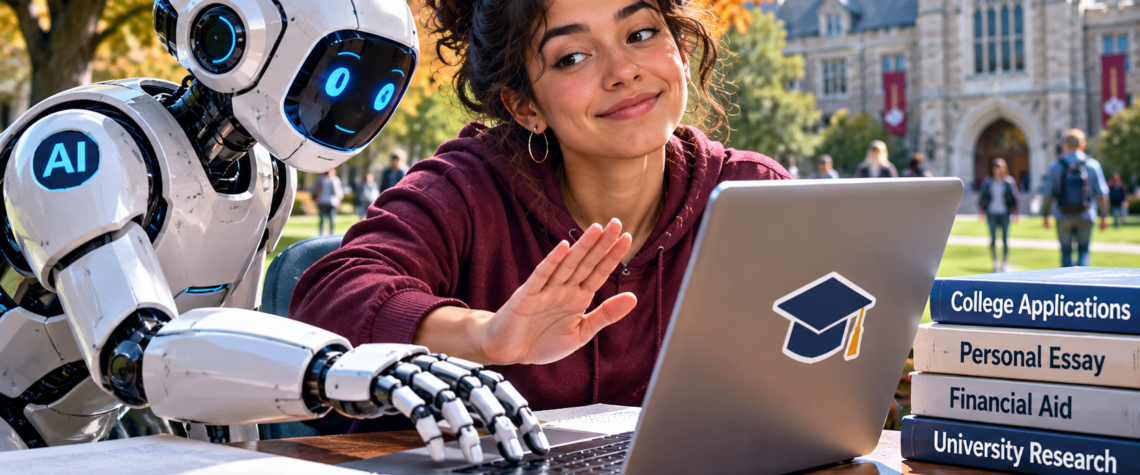
Artificial intelligence can help students research universities, organize deadlines, and prepare stronger applications. But when a chatbot starts writing their personal stories, the technology meant to help them may become a liability.
A high school senior sits in front of a computer, staring at one of the most intimidating questions in the college application process: Tell us about yourself.
The student has good grades, extracurricular activities, and ambitions for the future. But putting years of experiences, challenges, and aspirations into a few hundred compelling words seems overwhelming.
Then comes an appealing possibility. Why not ask ChatGPT to write the essay?
Within seconds, an artificial intelligence assistant can produce a polished personal statement about perseverance, leadership, intellectual curiosity, and personal growth.
The grammar is impeccable. The paragraphs flow naturally. The conclusion sounds inspiring. There is just one problem.
The essay might describe almost anyone. And at a growing number of universities, submitting AI-generated writing as your own could violate admissions policies.
As millions of students prepare college applications, artificial intelligence is becoming both a powerful resource and a potential obstacle. Used appropriately, it can make the process more manageable, especially for families without access to expensive admissions consultants. Used carelessly, it can undermine the authenticity that admissions officers are trying to evaluate. The challenge is understanding where assistance ends and misrepresentation begins.
A College Counselor Available Around the Clock
Applying to college involves considerably more than writing an essay. Students must research institutions, compare academic programs, understand admission requirements, evaluate costs, investigate financial aid, request recommendations, and meet multiple deadlines.
For families navigating the process for the first time, the amount of information can be intimidating. AI assistants can help organize these tasks.
A student interested in engineering, for example, might ask a chatbot to explain the differences between mechanical, electrical, and computer engineering programs.
Another student might request a checklist of materials commonly required for college applications or ask for an explanation of the differences between early action, early decision, and regular decision.
AI can also help families understand unfamiliar financial aid terminology, including grants, scholarships, student loans, and net price.
For students whose parents did not attend college, having an accessible tool that explains complicated procedures in plain language may be particularly valuable.
But AI should serve as a starting point for research, not the final authority.
Chatbots can provide outdated information, invent scholarship opportunities, misstate deadlines, or misunderstand individual university requirements.
Before acting on important information, applicants should verify it through official admissions and financial aid websites.
That is especially important when decisions involve binding admission agreements, scholarship eligibility, or substantial financial commitments.
The Most Dangerous Shortcut: Letting AI Write Your Essay
The personal essay occupies a special place in college admissions. Grades and test scores can demonstrate academic performance. Activities and recommendations provide additional context.
But the essay gives students an opportunity to communicate directly with admissions officers. It can reveal how they think, what they value, how they respond to setbacks, and what they have learned from their experiences.
Artificial intelligence can imitate the structure of a successful admissions essay. What it cannot independently provide is the applicant’s lived experience.
When thousands of students use similar prompts to generate personal statements, the resulting essays may share familiar themes, predictable language, and polished but generic conclusions.
The University of Rochester cautions that AI-generated essays can diminish an applicant’s distinctive voice and make the writing sound interchangeable with that of other students.
Northwestern University similarly warns that using AI to produce personal statements or supplemental essays makes it harder for admissions officers to understand the applicant.
The danger is not simply that an admissions officer might recognize AI-generated prose. It is that the student loses the opportunity to communicate something genuinely memorable.
A slightly imperfect essay containing a specific, revealing personal experience may be more effective than an elegant composition that says little about the person submitting it.
Universities Are Drawing Different Lines
There is no single nationwide rule governing the use of AI in college applications. Individual universities have adopted policies that range from detailed restrictions to more flexible guidance.
Yale University explicitly states that submitting substantial AI-generated content as original application work constitutes application fraud. It permits limited uses such as checking spelling and grammar or exploring possible topics, but warns that violations can have serious consequences.
Cornell University allows applicants to use AI to research colleges and build university lists. However, its undergraduate admissions policy prohibits using AI to outline, draft, write, or translate application responses.
The University of Pennsylvania takes an approach centered on authenticity. It permits tools that help applicants organize their thoughts or check grammar, while emphasizing that the ideas, experiences, and written content must remain the student’s own.
The University of Wisconsin–Madison has adopted a notably different position on enforcement. It says applicants will not automatically be disqualified for using or being suspected of using AI, and that the university does not run admissions essays through AI-detection software.
Nevertheless, Wisconsin strongly discourages students from having AI write their essays because doing so defeats the purpose of introducing themselves to the admissions committee.
These differences matter. A technique considered acceptable at one university may violate another institution’s requirements.
Students should therefore check the current AI policies of every institution to which they apply, particularly before using AI to draft, translate, restructure, or substantially edit an essay.
Could AI Actually Reduce Your Chances?
Emerging research suggests that excessive reliance on AI may carry measurable disadvantages. A September 2026 study by researchers associated with Stanford examined nearly 7,500 applications submitted between 2020 and 2025 to a large U.S. public policy master’s program.
The researchers found that, during the 2025 admissions cycle, a majority of applicants submitted at least one essay classified as primarily AI-generated, despite the program’s explicit prohibition.
They also found that applicants whose essays appeared to be AI-written were admitted less frequently than comparable applicants.
In an experiment, admissions officers often recognized AI-like writing and evaluated essays they believed were AI-generated less favorably.
The study offers an important warning, but its limitations should be understood.
It examined graduate admissions to a particular program, not undergraduate applications nationwide. The results therefore cannot establish that AI-assisted essays reduce admission chances by the same amount at every college.
The findings nevertheless reinforce a concern expressed by admissions offices: writing that sounds impressive but lacks individuality may work against the applicant. The lesson is not that students must avoid every AI tool.
It is that technology should help them express their own experiences rather than manufacture an artificial version of themselves.
Five Ways AI Can Genuinely Help
Used responsibly, AI can make college preparation more efficient without replacing the student’s judgment or creativity.
1. Research universities. Students can ask AI to explain differences among academic programs, campus environments, admission pathways, and institutional types. Official sources should be used to confirm specific requirements.
2. Organize deadlines. AI can help create application calendars, checklists, and schedules for essays, recommendation requests, financial aid forms, and campus visits.
3. Understand financial aid. Chatbots can explain unfamiliar terminology and help families prepare questions for financial aid offices. They should not be trusted to determine eligibility or calculate final aid packages without verification.
4. Prepare for interviews. Students can practice answering common interview questions and receive feedback on clarity, organization, and confidence, provided their answers remain truthful.
5. Reflect on personal experiences. Where university rules permit it, AI can ask questions that help students remember meaningful events, identify lessons, and consider what they want admissions officers to understand about them.
The fifth use requires particular care. A chatbot might ask, for example, what experience changed the student’s perspective on responsibility. The student should supply the answer.
The assistant should not invent an experience, select an artificial emotional lesson, or turn the student’s life into a formulaic success story.
The Difference Between Brainstorming and Ghostwriting
Consider two students preparing an essay about overcoming a difficult experience. The first asks AI to write a moving personal statement about resilience. The assistant produces a polished narrative describing obstacles, determination, and eventual success.
The student changes a few words and submits it. The second student, at a university that permits AI-assisted brainstorming, asks the assistant to pose questions that might help identify a meaningful personal experience.
After reflecting on those questions, the student chooses a specific event, writes the essay independently, and asks a teacher to review it. Both students used AI. But their relationship with the technology was fundamentally different.
The first delegated authorship. The second used AI as a limited tool to support reflection while retaining control over the work.
Not every university permits every form of brainstorming or editing, so students should consult the institution’s rules before following either process.
The guiding principle is simple: the application should represent the person seeking admission, not the writing abilities of a software system.
What About AI Detection Software?
Some students worry that universities may use AI-detection tools to identify chatbot-generated essays. These systems analyze patterns in writing and estimate whether a passage resembles text produced by artificial intelligence. But detection is not definitive proof of authorship.
Human writing can be incorrectly classified as AI-generated, and AI-generated writing can sometimes evade detection.
The University of Rochester notes that such tools are imperfect, while Wisconsin–Madison explicitly says it does not use them to screen admissions essays.
The Common Application also does not use AI-detection software to validate applicants’ essays, according to statements reported in November 2026.
This does not mean students are free to submit AI-generated work. Universities may investigate suspected violations of application integrity through other procedures, and applicants are generally required to certify that their submissions are truthful and their own work.
Students should not approach the application process as a contest to evade detection.
The more important question is whether the submitted work honestly represents their thinking, experiences, and abilities.
An Opportunity—and a New Inequality
AI may also change the economics of college preparation. Families with substantial resources have long been able to hire private counselors, writing coaches, and specialized admissions consultants.
Students without those advantages often depend on overextended school counselors, public information, and their own research.
Free or inexpensive AI tools could help narrow some of that gap. A first-generation college applicant might use AI to understand application terminology, compare financial aid options, or organize a complicated set of requirements.
A student who speaks English as a second language might use approved language-support tools to better understand instructions. But there is another possibility.
Students with greater financial resources may have access to more advanced AI systems, private coaching on how to use them, and additional human guidance.
Meanwhile, applicants unfamiliar with institutional AI policies may unknowingly use the technology in ways that violate application rules.
Universities therefore face their own challenge: explaining acceptable AI use clearly enough that applicants from different educational and economic backgrounds understand the expectations.
Fairness requires more than prohibiting dishonest submissions. It also requires making the rules understandable.
Before You Submit: A Practical Checklist
Students preparing applications should take several precautions.
- Read the AI-use policy of every college on your application list.
- Write personal statements and supplemental essays in your own words.
- Do not invent activities, awards, hardships, or accomplishments.
- Use AI for organizational and research tasks, and for writing assistance only when explicitly permitted.
- Verify deadlines, scholarship information, and admission requirements through official sources.
- Keep your own drafts and notes to document your writing process.
- Avoid uploading unnecessary personal information, recommendation letters, or confidential school records to AI services.
Above all, ask whether you could comfortably explain every statement in your application during an admissions interview.
If the answer is no, the application may no longer accurately represent you.
The One Thing AI Cannot Supply
College admissions have never been entirely predictable.
Universities evaluate applicants through different combinations of academic performance, extracurricular involvement, personal experiences, recommendations, and institutional priorities.
Artificial intelligence cannot guarantee admission.
It cannot manufacture genuine intellectual curiosity, sustained commitment, or the personal qualities that emerge through lived experience.
What it can do is help students navigate an increasingly complicated process.
That is a meaningful contribution.
But the most valuable part of a college application remains something no chatbot can produce on its own: an authentic account of who the applicant is.
The goal is not to sound like the perfect student.
It is to help an admissions committee understand the real one.
Sources and Further Reading
- Yale University, AI Policy, Undergraduate Admissions.
- Cornell University, Receiving Help With Your Application, Undergraduate Admissions.
- University of Pennsylvania, Integrity and AI Use in the Admissions Process.
- University of Wisconsin–Madison, Use of AI in Admissions Essays.
- Northwestern University, Artificial Intelligence and Admission.
- University of Rochester, How to Write Your Best College Application Essay, 2026.
- Isley, Gaebler, and Goel, AI-Written Admissions Essays Are Widespread But Penalized, September 2026, preprint available through Stanford SCALE.